Content Areas for CMP Maintenance

The Content Areas in which interpreters/transliterators can receive Continuing Education Units (CEUs) are divided into two categories: Professional Studies (linguistic and cultural studies; theoretical and experiential studies; specialization studies) and General Studies (human service and leadership; general knowledge studies). In determining the Content Areas, the RID Professional Development Committee (PDC) considered the recommended standards in the curriculum section of the Conference of Interpreter Trainers’ (CIT) Educational Standards Package.

  • Professional Studies 

Professional Studies contain content that directly applies or affects the field of interpreting/transliterating. These are areas of investigation that enhance the interpreting process regardless of the setting. They are studies that deepen the member’s ability to provide excellence through their work. A minimum of 6.0 CEUs must be completed in this section during each Certification Maintenance Cycle. Examples of Professional Studies topics include, but are not limited to:


  1. Advanced studies of language, culture, and human behavior: Languaculture; intracultural and intercultural dynamics; and linguistic systems. Examples include, but are in no way limited to: 
  • Studies of Language and Linguistic Structure of ASL
    • Phonology, morphology, syntax, semantics, pragmatics
    •  Language variation and language change 
  • Sociolinguistics
    • Language and power 
    • Language and cognition
    • Language Studies
      • Advanced English development (specialized vocabulary, grammar development, analysis of linguistic register, etc.) 
      • Advanced ASL development (specialized vocabulary, grammar development, analysis of linguistic register, etc.) 
      • Other advanced languages studies: e.g., Spanish, Japanese, Langue des Signes Francaise (LSF), Deutsche Gebärdensprache (DGS) 
  • Languaculture and Cultural Studies (Note: languaculture refers to language mechanics and the use of language, including cultural components that inform the use of language, such as history and traditions. Term attributed to anthropologist Michael Agar.) 
    • Intracultural dynamics 
      • Communication studies (e.g., interpersonal communication)
      • Studies of group dynamics 
      • Language as power
    • Cultural Studies 
      • Deaf culture
      • American culture
      • Religious Studies 
    • Intercultural dynamics 
      • Studies of power, privilege and bias
      • Studies of social justice
      • Cross-cultural studies
      • Minority group dynamics
      • Language domination, suppression and elevation


  1. Theoretical and Experiential Studies: The process of interpreting/transliterating through the direct application of systems of principles, philosophy, ideas or concepts. Examples include: 
  • History and issues in interpretation and transliteration 
  • Theory of interpretation and transliteration 
  • Skills development in interpretation and/or transliteration 
  • Skills development in consecutive and simultaneous interpretation 
  • Professional ethics, etc. 


  1. Specialization Studies: Huge growth of the interpreting field has led many interpreters to specialize or focus in one or two settings of specialty. Commonly these are areas such as medical or mental healthcare, legal work or work in education at the K-12 level or in post-secondary settings. This requires interpreters to build competence and knowledge in areas of expanded technical vocabulary or systems knowledge that is not common or generally necessary for the generalist interpreter. Building skills in more narrowly focused areas within the broader field of interpreting or transliterating. Documentation must be present detailing the way in which the activity relates to the development of interpreting skills in that particular field or setting. Examples include aspects of:
  • Educational settings (e.g., philosophies of Deaf education, graduate research strategies)
  • Rehabilitation settings
  • Legal settings (e.g., courtroom protocol, mediation law)
  • Medical or mental health settings (e.g. medical terminology, anatomy & physiology in ASL and English) 
  • Substance abuse recovery programs 
  • Technical areas 
  • Ethics as applied in specialized settings, etc. 


  1. Power, Privilege & Oppression​: Refers to the phenomena by which members of a society are unfairly advantaged and may be unaware of – or unwilling to recognize – the advantage. The result is oppression at the systemic, societal, and individual level wrongfully limiting another’s access to resources. This is rooted in the perception of entitlement – or lack thereof- based on social group membership and may manifest in covert and overt practices/behaviors that seek to keep that advantage, and result in abuse of assumed power and privilege. All of which contribute to perpetuating the privilege, individual biases, and social and systemic oppression. These behaviors can be but are not limited to:
  • Narratives/perspectives of fear and hate/stereotyping by those who are privileged
  • Assumed authority/dominance over “others” (internalized biases)
  • Agent & Target group membership ( e.g., exclusionary/preferential practices)
  • Control over social mobility
  • Unearned advantages and conferred dominance
  • Systems of oppression (e.g. ableism, ageism, audism, classism, racism,sexism, heterosexism, transgender oppression, vidism, etc. )
  • Dynamics of oppression (e.g. institutionalized oppression, prejudice, vertical and horizontal violence/bullying, etc.)
  • Stereotyping
  • Marginalization
  • Support of the status quo
  • Avoidance of conversations about “-isms”
  • Creation of barriers (e.g. poverty, unemployment, and the school to prison pipeline)
  • Unbalanced (or inequitable) access to wealth, professional/educational opportunities, social status
  • Internalized supremacy


Consistent with the RID Code of Professional Conduct, interpreters are required to develop the sensitivity needed to identify such phenomena, and build competence and knowledge in the following areas with a goal of promoting and practicing social justice and dismantling oppressive systems. Education in this sector should include, but not be limited to:

  • Challenging injustice
  • Respecting and valuing diversity
  • Respecting and valuing humanity
  • Protection of equal access
  • Identifying and embracing individual “filters”
  • Identifying and acknowledging individual perceptions of privilege
  • Changing the narratives of compassion and respect
  • Promoting inclusion, freedom and equality
  • Challenging the status quo
  • Engaging in conversations about “-isms”
  • Removal of barriers
  • Social Justice/Liberation studies
  • Cultural competence
  • Identity
  • Intersectionality
  • Invitational communication/interaction
  • Accountability
  • Trauma-informed approaches to interpreting

Some Clarifying Notes about PPO CEUs


  • General Studies 

General Studies include topics that enhance the interpreter/transliterator’s base of general or world knowledge. The study must still be a legitimate educational program with clearly defined educational goals and measurable objectives. There are no minimum requirements for CEUs in this category, however, only two (2) of the eight (8) required CEUs will be counted toward certification maintenance.
Some Clarifying Notes about PPO CEUs

Programming that has the PPO designation should delve into content that covers systems of power, privilege, and the matrix of domination that create oppression, and how participants affect and are affected by these systems. 

Targets of oppressive systems can include, but are not limited to, people who are Black or Brown and/or identify as Black Indigenous People of Color (BIPOC); people who are members of racial or ethnic minority groups; members of the Deaf, DeafBlind, DeafDisabled, Hard-of-Hearing, Coda, and Late-Deafened communities; people with disabilities; people who are neurodivergent; women; people from religious minorities; members of the LGBTQIA+ community; people from minority political ideologies (e.g., Marxists); immigrants and New Americans (in the US); people whose first language is not English (in the US), etc.

PPO programming entails a praxis – putting theory into action – where participants reflect on their own relationship to systems of power, privilege, and oppression. Programming that focuses primarily on individuals’ sharing of their personal and professional lived experiences is not sufficient to earn the PPO designation. 

In order to meet the requirements for the PPO CEUs programming content area, programming must create opportunities and processes for participants to:

  • practice identifying and understanding systems of power, privilege, and oppression; 
  • engage in conversations, not only within the context of professional development, but also more broadly with other people about systems of oppression in society and how to work toward dismantling those systems in service of a more egalitarian society; 
  • and develop a practice where participants assess the contexts they find themselves in, and identify for themselves how they wield their own power and privilege when making decisions in order to reduce their own contributions to systems of oppression. 

Sponsors should consider the following questions when reviewing proposed programming, which include, but are not limited to: 

Does this programming ask: 

  • Are participants aware that systems of power, privilege, and oppression treat different groups in society differently?
  • Are participants aware of the matrix of domination and how it creates oppressive harm, which impacts individuals and groups in different ways?
  • Are participants aware of examples of oppressive harm?
  • Are participants aware of what bias is, and are they aware of their own biases?
  • Are participants aware that systemic biases exist? 
  • Are participants aware of how their own biases might, or do, exacerbate situations that are already oppressive toward some individuals? 
  • Can participants identify and describe ways in which they have been targets of oppressive systems? (not all participants will have had this experience)
  • In retrospect, can participants identify ways they have knowingly or unknowingly negatively impacted others within already-oppressive situations?
  • Can participants identify tools and resources to help them assess contexts and identify ways to wield their power and privilege when making decisions in order to reduce their own contributions to systems of oppression?
  • Can participants identify tools and resources to help them minimize (and, ideally, eliminate) oppressive harm in situations?  
  • Can participants identify tools and resources to help them minimize the power of (and, ideally, eliminate) oppressive systems?


Workshop Requirements

Hosts using UTRID as a CMP sponsor have responsibilities they must adhere to in order to get CEUs for themselves and/or for workshop participants. Failure to adhere to these responsibilities or to follow UTRID’s guidelines may lead to the inability to get CEUs. Please refer to Continuing Education Activity Form for steps and a full list of requirements.

Activities are presented for group instruction or for individual study. Examples include short courses, workshops, seminars, conferences, teleconferences, and distance learning (e.g. continuing education publications, teleconferences, multimedia instruction materials, and programmed learning materials)

The Host shall provide activities that meet the following requirements: 

1. The educational content should follow the stated objectives of the continuing education activity.
2. The continuing education activity should be of sufficient duration to achieve the stated educational objectives.
3. The content of the continuing education activity should be designed to explore one
subject or a group of closely related subjects. If the activity involves multiple components, such as in a lecture series, all segments should be devoted to integrally related subjects.
4. The audiovisual aids and supportive materials should be current, suitable and appropriate.
5. The method of delivery should allow for and encourage active involvement on the part of the participant, feedback, and reinforcement of the learned knowledge or skill.
6. The Host shall verify that members of the teaching staff of all continuing education
activities are qualified (credentials, training, experience and expertise in the subject
matter to be presented). All instructors should demonstrate high ethical standards of
professional conduct and be sensitive to RID members’ individual differences with regard to age, gender, socioeconomic, ethnic and cultural backgrounds, disability, and sexual orientation.
7. The Host shall formulate plans for advanced continuing education activities suitable for certified interpreters.

Hosts must complete a Continuing Education Activity Plan 45 days in advance to allow the CMP team to process the submission. The CMP team is a volunteer position and individuals serving often have other responsibilities.

The following information is required on the Plan:

  1. Target Audience: The Sponsor shall define the target audience for each continuing
    education activity. In planning the activity, Sponsors should assess the needs of the
    target audience. The target audience should be clearly specified in all promotional
    outreach, media, and materials.
  2. Educational Objectives: The Sponsor shall specify the observable, measurable
    educational objectives of each continuing education activity. These objectives must be
    published in promotional outreach, media, and materials announcing the activity.
  3. Content Knowledge Level: The content knowledge level is related to participant’s
    familiarity with the topic, regardless of their interpreting skill or experience. The content knowledge level should be classified according to the following definitions.

3.1 Little/NO: This level assumes little or no information on the part of the
participant within the topic area. The focus of the activity is a general orientation
and increase of understanding. This category also includes activities that assume
the audience to have diverse levels of knowledge due to the nature of the event.
For example, professional issue forum, conference, discussion group, etc.
3.2 Some: This level assumes the participant has some familiarity with the literature and professional practice within the topic covered. The general focus of the activity is to increase understanding and application of the participant.
3.3 Extensive: This level assumes the participant has extensive familiarity with current literature and professional practice within the topic covered. The focus of the activity is upon recent advances, future directions and applications of research.
3.4 Teaching: This level assumes the participant to be educators of interpreters. At this instructional level, the content of the CEU activity will focus on acquisition of current pedagogical techniques for the preparation of interpreters/transliterators.

The Host shall specify the content knowledge level of each activity in all promotional media, outreach or material efforts.

4. Content Area: The host shall specify the Content Area of each Activity in all
promotional media, outreach and materials. The Content Areas should be specified as
Professional Studies or General Studies. These areas are described in detail here:  https://utrid.com/content-areas/

The Host shall verify participant attendance and completion of all course materials and requirements of each submitted activity.

Source:RID Standards and Criteria

Content Areas

The Content Areas in which interpreters/ transliterators can receive Continuing Education Units (CEUs) are divided into two categories: Professional Studies (linguistic and cultural studies; theoretical and experiential studies; specialization studies) and General Studies (human service and leadership; general knowledge studies). In determining the Content Areas, the RID Professional Development Committee (PDC) considered the recommended standards in the curriculum section of the Conference of Interpreter Trainers’ (CIT) Educational Standards Package.


Professional Studies
Professional Studies contain content that directly applies or affects the field of interpreting/transliterating. These are areas of investigation that enhance the interpreting process regardless of the setting. They are studies that deepen the member’s ability to provide excellence through their work. A minimum of 6.0 CEUs must be completed in this section during each Certification
Maintenance Cycle. Examples of Professional Studies topics include, but are not limited to:

1. Advanced studies of language, culture, and human behavior: Languaculture; intracultural and intercultural dynamics; and linguistic systems. Examples include but are in no way limited to:

      • Studies of Language and Linguistics
          • Structure of ASL
          • Phonology, morphology, syntax, semantics, pragmatics
          • Language variation and language change
          • Sociolinguistics
          • Language and power
          • Language and cognition
          • Language Studies
            • Advanced English development (specialized vocabulary, grammar
              development, analysis of linguistic register, etc.)
            • Advanced ASL development (specialized vocabulary, grammar
              development, analysis of linguistic register, etc.)
            • Other advanced languages studies: e.g., Spanish, Japanese, Langue des
              Signes Francaise (LSF), Deutsche Gebärdensprache (DGS)
      • Languaculture and Cultural Studies (Note: languaculture refers to language mechanics and the use of language, including cultural components that inform the use of language, such as history and traditions. Term attributed to anthropologist Michael Agar.)
          • Intracultural dynamics
            • Communication studies (e.g., interpersonal communication)
            • Studies of group dynamics
            • Language as power
          • Cultural Studies
            • Deaf culture
            • American culture
            • Religious Studies
          • Intercultural dynamics
            • Studies of power, privilege and bias
            • Studies of social justice
            • Cross-cultural studies
            • Minority group dynamics
            • Language domination, suppression and elevation

2. Theoretical and Experiential Studies: The process of interpreting/transliterating through the direct application of systems of principles, philosophy, ideas or concepts. Examples include:

      • History and issues in interpretation and transliteration
      • Theory of interpretation and transliteration
      • Skills development in interpretation and/or transliteration
      • Skills development in consecutive and simultaneous interpretation
      • Professional ethics, etc.

3. Specialization Studies: Huge growth of the interpreting field has led many interpreters to specialize or focus in one or two settings of specialty. Commonly these are areas such as medical or mental healthcare, legal work or work in education at the K-12 level or in post-secondary settings. This requires interpreters to build competence and knowledge in areas of expanded technical vocabulary or systems knowledge that is not common or generally necessary for the generalist interpreter. Building skills in more narrowly focused areas within the broader field of interpreting or transliterating. Documentation must be present detailing the way in which the activity relates to the development of interpreting skills in that particular field or setting. Examples include aspects of:

      • Educational settings (e.g., philosophies of Deaf education, graduate research
        strategies )
      • Rehabilitation settings
      • Legal settings (e.g., courtroom protocol, mediation law)
      • Medical or mental health settings (e.g. medical terminology, anatomy & physiologyin ASL and English)
      • Substance abuse recovery programs
      • Technical areas
      • Ethics as applied in specialized settings, etc.

Some Clarifying Notes about PPO CEUs

General Studies

General Studies include topics that enhance the interpreter/transliterator’s base of general or world knowledge. The study must still be a legitimate educational program with clearly defined educational goals and measurable objectives. There are no minimum requirements for CEUs in this category, however, only two (2) of the eight (8) required CEUs will be counted toward certification maintenance.


Source: RID Standards and Criteria

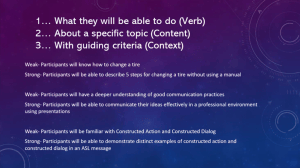
Effective Learning Objectives

Learning/educational objectives should achieve three primary objectives by providing:

  • Insight into the expected learning for potential participants of an event. Learning objectives or outcomes should clearly delineate what the Participant can expect to learn and apply to their work.
  • Guidance to Facilitators/Instructors in the preparation and fulfillment of educational activities by ensuring that the educational activity remains focused and meets the appropriate level of instruction within the time defined.
  • Information to the Sponsor to determine whether the activity is one that is deserving of CEUs and the applicable Content Level. 

More information can be found in this issue of the VIEWS and provided by the University of Alaska.

There are more resources available on the web by searching specific and measurable learning objectives

From Workshop Proposals: Fizzle or Flame:

Planning and hosting a workshop

  1. Find a Presenter/Facilitator for the workshop
  2. Ask the Presenter/Facilitator to complete the  Workshop Proposal Form.
  3. Prepare and Send Contract to Presenter/Facilitator for signature
  4. Complete the Workshop Form (45 days in advance is the standard)
  5. Announce and Publicize the Workshop
  6. Add the name of the workshop to the Check in form & the Evaluation form
  7. Add the Certificate of Completion to the Page on UTRID
    1. Don’t forget to add the activity number to the certificate
  8. Check registration in WooCommerce on UTRID.com
  9. Send Links for Zoom or personalized qr tickets 
  10. Host the workshop
    1. Take roll (use the UTRID online forms) Check-in
    2. Monitor the names as they are entered in the Master Registration Check In tab
    3. Collect evaluations (use the UTRID online forms) Eval
  11. Complete the Activity Report Form

Check in QR https://bit.ly/UTRIDzoom
Eval QR http://bit.ly/UTRIDeval


Academic Coursework

Academic Coursework Guidelines

*Those using UTRID as a CMP sponsor have responsibilities they must adhere to in order to get CEUs for themselves or for workshop participants. Failure to adhere to these responsibilities or to follow UTRID’s guidelines may lead to the inability to get CEUs.*

Steps to receive CEUs for Academic Coursework

Academic coursework is the only program that does not require prior approval from a CMP sponsor.

  1. Review RID’s instructions to complete the Academic Coursework form here
  2. Complete payment if required (Members receive 1 per year as a benefit of membership, each additional is $10. Only purchase if you have exhausted your yearly benefit.)
  3. Complete the Academic Coursework form
    1. Paper form for reference only: Academic Coursework
    2. You will need
      1. Course syllabus
      2. Official transcript showing a grade of “C” or better was obtained in that class.
    3. Upload documentation as instructed in the form
  4. Work with CMP sponsor to determine:
    1. Number of CEUs
    2. Type of CEU – Professional Studies or General Studies (a written statement may be required if trying to get PS for a class that does not fit the PS definition as set forth by RID.)
  5. Complete all steps before the end of the member’s cycle.
**Note on Paper forms: While you can opt to use paper forms to gather the necessary information, you will need to convert this to a digital format or transfer the information to the correct online form. This will expedite the processing of the credits. Do not submit scanned, handwritten forms as you will be asked to re-submit digitally and this will delay the processing of your credits.**

CMP Processing Fees

Individuals

PINRA:   Members receive 3 per year as a benefit of membership, each additional is $10 / Non-members $20

Independent Study: Members receive 1 per year as a benefit of membership, each additional is $10 / Non-members $20

Academic Coursework: Members receive 1 per year as a benefit of membership, each additional is $10 / Non-members $20

**Members: only purchase processing if your annual benefit has been exhausted**

Workshops & Conferences

Workshops: Organizational members receive 6 per year as a benefit of membership, each additional is $25 / Non-members $75

Conferences: Will be negotiated on a case by case basis

**Members: only purchase processing if your annual benefit has been exhausted**

*Those using UTRID as a CMP sponsor have responsibilities they must adhere to in order to get CEUs for themselves or for workshop participants. Failure to adhere to these responsibilities or to follow UTRID’s guidelines may lead to the inability to get CEUs.*

Certification Maintenance Program (CMP) Sponsor

UTRID is an approved RID CMP Sponsor for Continuing Education.

CMP processing is one of the many benefits of UTRID membership. Members enjoy complimentary and discounted processing fees. View our processing fees.

Please submit all required information for your request to be processed in a timely fashion. Missing data will slow processing.


Host a workshop with approved CEUs by completing a Continuing Education Activity Plan

PINRA submissions are currently delayed, please plan on additional time to receive approval or select an alternate sponsor. PINRA Participant Initiated Non-RID Activities – Include activities that an interpreter/transliterator wishes to attend but which are not offered by an RID approved sponsor. The activity must be sponsored by an organization with specific known standards and must have a specific format, educational objectives and purpose. (note: PINRAs should not be used for sponsor initiated activities or group activities.)

Independent Study Plan – Activities include research, curriculum development, or enhancement projects, study groups, developing effective mentoring strategies or evaluation rubric or the preparation of scientific/clinical materials for publication

Academic Coursework – Awarded for Academic Coursework taken from an accredited institution during the participant’s current cycle.

If you would like to present a workshop for UTRID, please complete the Presenter Application

For questions or help completing the forms, please email CMP.utrid@gmail.com

Sample Paper Forms  (Registration, Check-in, Evaluation, Certificate, Activity Report form)
**Note on paper forms: While you can opt to use paper forms to gather the necessary information, you will need to convert this to a digital format or transfer the information to the correct online form. This will expedite the processing of the credits. Do not submit scanned, handwritten forms as you will be asked to re-submit digitally and this will delay the processing of your credits.**
*Those using UTRID as a CMP sponsor have responsibilities they must adhere to in order to get CEUs for themselves or for workshop participants. Failure to adhere to these responsibilities or to follow UTRID’s guidelines may lead to the inability to get CEUs.*

PINRA (Participant Initiated Non-RID Activity)

*Those using UTRID as a CMP sponsor have responsibilities they must adhere to in order to get CEUs for themselves. Failure to adhere to these responsibilities or to follow UTRID’s guidelines may lead to the inability to get CEUs.*

Steps to complete a PINRA and receive CEUs

PINRA submissions are currently delayed, please plan on additional time to receive approval or select an alternate sponsor.

  1. Review RID’s guidelines on PINRA qualifications (Note: PINRAs should not be used for sponsor initiated activities or group activities.)
    1. The activity must be Sponsored by an organization with standards specific to its area of expertise. The activity must have a defined format and clearly identified educational objectives. If the application to interpreting is unclear, the application should provide a single page or more describing how attending the activity will improve the applicant’s interpreting work. PINRAs include but are not limited to: auditing a college course, non-credit courses at an educational institution, association or corporate trainings (e.g., American Bar Association, Teacher’s Union, and Social Work Association), school district in-service or an organization’s conventions/workshops. Administrative paperwork is processed by the Sponsor.
  2.  Complete payment if required (members: only pay if your member benefits have been exhausted, 3 per year)
  3. Complete the PINRA form online BEFORE attending the event (45 days minimum)
    1. For instructions, open RID’s Detailed guide for completing a PINRA in a separate window.
    2. Here is the Paper form for reference only
    3. Upload supporting materials such as event description, conference agenda, learning objectives, flyers, brochures, etc.
    4. Please submit all required information for your request to be processed in a timely fashion. Missing data will slow processing.
  4. Work with the CMP Sponsor to determine:
    1. Number of CEUs and if they are Professional Studies or General Studies
    2. How to prove attendance / participation
  5. Attend the Event
    1. Photograph certificates or other attendance / participation verification materials as agreed upon with the CMP Sponsor
  6. Complete the online PINRA Completion form  within 10 days of event.
    1. Upload photos of attendance / participation verification materials as instructed
PINRA submissions are currently delayed, please plan on additional time to receive approval or select an alternate sponsor.
**Note on Paper forms: While you can opt to use paper forms to gather the necessary information, you will need to convert this to a digital format or transfer the information to the correct online form. This will expedite the processing of the credits. Do not submit scanned, handwritten forms as you will be asked to re-submit digitally and this will delay the processing of your credits.**